







Why a Complete Generator Load Test Matters More Than a Certificate
Introduction
A diesel generator that starts successfully is not necessarily a reliable generator.
The real question is what happens when the load is applied.
Can it maintain stable voltage and frequency? Can the engine accept a sudden load? Can the cooling system control temperature at full output? Can the generator continue operating without alarms?
For mining, data centers, oil and gas, rental power, and industrial projects, these questions matter far more than whether the engine simply starts.
That is why a complete generator load test is one of the most important checks before delivery.
A certificate can confirm specifications or compliance. A factory load test verifies how the actual generator performs.
Starting the Generator Is Only the First Step
During an inspection, customers may see the engine start normally, the controller display no alarms, and the generator run smoothly at no load.
That is useful—but it is only the beginning.
A generator must also remain stable when supplying real loads such as motors, pumps, compressors, cooling equipment, industrial machinery, or critical data center systems.
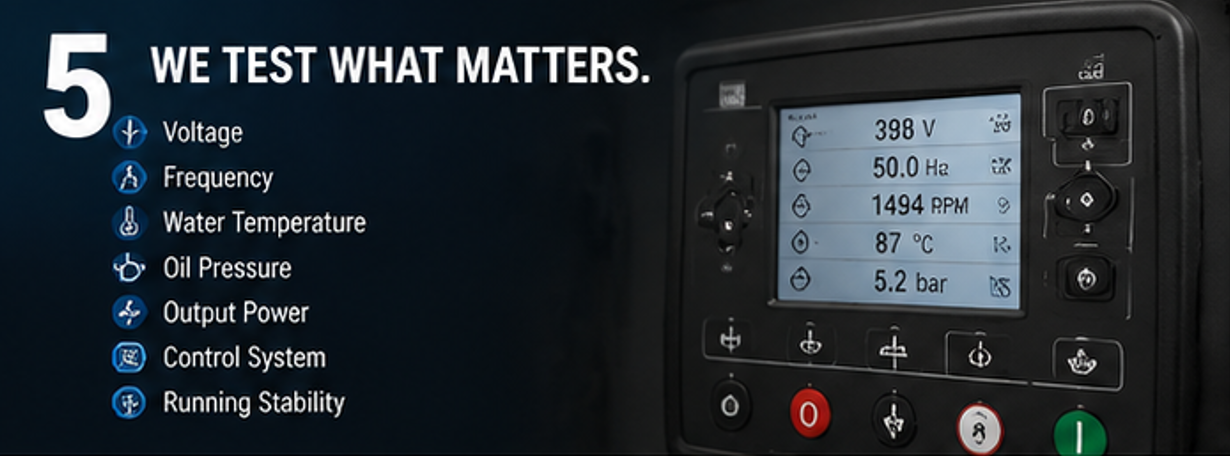
A proper generator load test verifies whether the complete system can maintain:
Test Item | What It Confirms |
Output voltage | Stable electrical output |
Frequency | Stable engine speed and regulation |
Engine speed | Proper response under load |
Coolant temperature | Cooling system performance |
Oil pressure | Engine lubrication condition |
Output power | Rated power capability |
Control system | Alarm and protection functions |
Operating stability | Reliable performance over time |
This is why simply starting a generator before shipment is not enough.
Why Test 100% Load Acceptance?
In some projects, Voltgent also performs a 100% step-load test.
Instead of gradually increasing the load, the generator must accept the rated load directly from a no-load condition.
This puts much greater demand on the complete system.
If the engine has insufficient power reserve, the governor responds too slowly, or the engine and alternator are not properly matched, the test may reveal:
· Engine speed drop
· Frequency deviation
· Voltage fluctuation
· Poor transient response
· In severe cases, engine shutdown
A successful 100% load acceptance test therefore provides useful evidence of the generator’s dynamic response.
However, step-load requirements should always be evaluated according to the engine, generator rating, and specific project requirements.
Why Does Voltgent Test from 0% to 110%?
A single load point cannot show the complete operating condition of a generator.
Voltgent therefore uses a progressive factory load test to observe the genset at different output levels.
Load Level | Test Time | Purpose |
0% | 2 min | Check starting and no-load operation |
25% | 2 min | Verify light-load stability |
50% | 2 min | Check normal operating performance |
75% | 2 min | Verify high-load operation |
100% | 20 min | Confirm sustained full-load performance |
110% | 2 min | Verify short-term overload response when applicable |
This process helps verify the engine, alternator, cooling system, controller, and protection functions as one complete power system.
Why Run at 100% Load for 20 Minutes?
Some problems do not appear immediately after load is applied.
A generator may look stable during the first few minutes, while temperature, oil pressure, cooling performance, or electrical output may change as the unit continues operating.
Running at 100% load for 20 minutes allows engineers to monitor whether: the coolant temperature stabilizes, oil pressure remains normal, voltage and frequency stay within the required range, and the generator can continuously deliver its rated output.
For prime-power and continuous-operation projects, this part of the load bank test is particularly important.
WHAT WE TEST
Factory Load Testing Is More Than a Power Check
The purpose of a diesel generator load test is not simply to see whether the generator can reach a certain kW or kVA figure.
It verifies the complete relationship between the engine, alternator, cooling system, controller, protection system, and electrical output.
This is also why factory testing can identify problems that may not be visible during assembly or no-load operation.
Finding them at the factory is far easier than discovering them after the generator has arrived at a mine, data center, factory, or remote project site.
Customer Value
A certificate tells you what a generator is supposed to meet. A complete generator load test shows how the actual machine performs.
For mining, data center, oil and gas, and industrial projects, thorough factory testing reduces commissioning risk, shortens site acceptance time, and gives greater confidence that the generator will perform reliably under real operating conditions.
Quality is not only certified. It is tested.
How Voltgent Tests Generators Before Delivery
At Voltgent, every generator is tested before shipment according to the required factory test procedure.
Depending on the project, testing can include progressive load bank testing, full-load operation, load acceptance, alarm and protection verification, ATS testing, and other customer-specific FAT requirements.
Our objective is simple: the generator should prove its performance before it reaches the customer’s site.
A reliable generator should not only look complete on the production line. It should demonstrate stable performance under real electrical load.
FAQ
Q: What is a generator load test?
A: A generator load test applies controlled electrical load to a generator to verify power output, voltage, frequency, cooling, engine performance, and protection functions.
Q: Why is a no-load test not enough?
A: A generator may start normally without load while showing problems only after motors, industrial equipment, or other real loads are connected.
Q: Why is 100% load testing important?
A: Full-load testing confirms whether the generator can continuously deliver its rated output while maintaining stable temperature, oil pressure, voltage, and frequency.
Q: What does a 110% generator load test verify?
A: When applicable to the generator rating and project requirements, a short 110% test can verify overload response and protection performance.
Q: Can Voltgent perform customized FAT requirements?
A: Yes. Testing can be adapted to project requirements, including load-bank testing, ATS, synchronization, protection logic, and other customized systems.
Contact Us
If you are planning a new power project, send Voltgent your load list, application, operating conditions, voltage, frequency, temperature, and altitude. Our team can help you select a suitable diesel generator solution.
Need help selecting the right generator for your next project?
Contact Voltgent to discuss diesel generator solutions, ATS, parallel systems, and customized configurations.


